
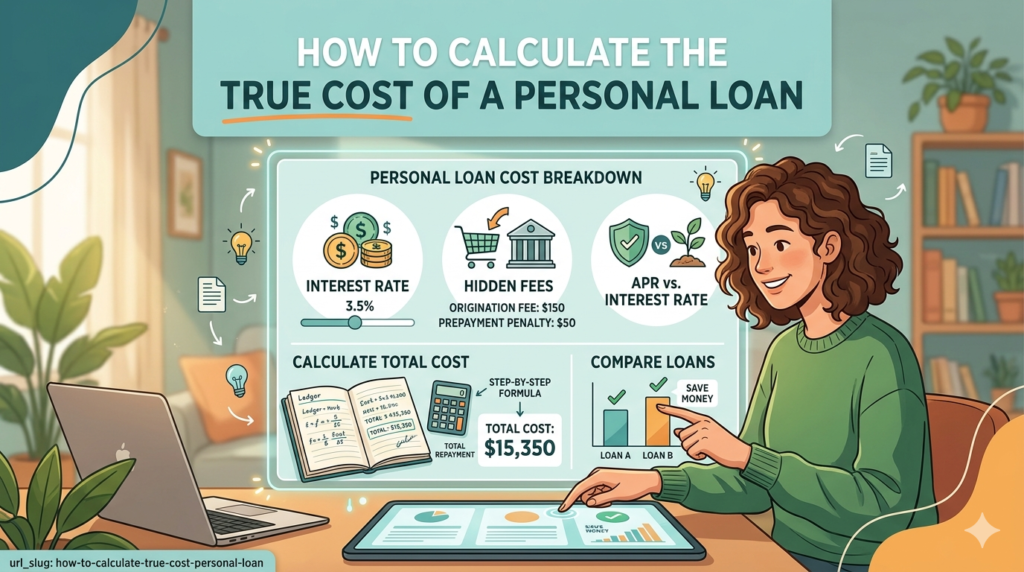
Here’s something lenders hope you won’t do: the math.
Not the easy math. Not the “my monthly payment is $280, I can swing that” math. The real math, the kind that tells you how much money actually leaves your pocket by the time that loan is dead and buried.
Because the interest rate you see on the offer page? That’s just the appetizer. The true cost of a personal loan includes fees you didn’t ask about, a repayment term that quietly doubles your interest, and sometimes a penalty for trying to pay it off early. Yes, really.
Let’s walk through how to actually figure out what a personal loan is going to cost you — before you sign anything.
The Interest Rate Is Not the Full Story
Let’s say your friend Marcus got a personal loan at 9% interest. Sounds fine. Another friend, Dana, got one at 10%. Sounds worse — but Dana’s lender charged zero fees. Marcus’s lender charged a 4% origination fee.
Guess who paid more? Marcus.
That’s the trap most people fall into. They compare interest rates like they’re the whole story, when really they’re just the first chapter.
Two loans with the same interest rate can cost completely different amounts depending on the fees attached, how long you take to repay, and whether there are any sneaky penalty clauses buried in the agreement.
The only number that tells the whole truth is your total cost of borrowing every dollar you pay back, minus the amount you actually received.
Step 1: Get Clear on APR vs. Interest Rate
Before you crunch any numbers, you need to know the difference between these two. Lenders use them interchangeably, but they’re not the same thing.
Interest rate = the annual cost of borrowing the principal. Nothing else included.
APR (Annual Percentage Rate) = the interest rate plus most mandatory fees, rolled into one annual figure.
APR is the more honest number. It’s what you should always use when comparing loan offers. A loan with a lower interest rate but a higher APR is actually more expensive — full stop.
Here’s the basic APR formula if you want to check a lender’s math:
APR = ((Interest + Fees) ÷ Loan Amount) ÷ Days in Loan Term × 365 × 100
One thing to know: APR still doesn’t include every possible charge. Late fees and returned payment fees aren’t baked in, because not everyone pays late. So even APR isn’t the complete picture, which is why you need to keep going.
Step 2: Calculate How Much Interest You’ll Actually Pay
Most personal loans are amortizing loans, meaning your payment stays the same every month, but the split between interest and principal shifts over time. Early on, most of your payment goes to interest. Later, more goes to the actual balance.
Here’s a simple example so you can see how it works:
Loan: $10,000 at 12% APR for 3 years (36 months)
- Monthly rate: 12% ÷ 12 = 1% per month
- Month 1 interest: $10,000 × 0.01 = $100
- Fixed monthly payment: ~$332
- So $100 goes to interest, $232 goes to the balance
- Month 2: balance is now $9,768 × 0.01 = $97.68 in interest
- This keeps going until the loan is paid off
Total paid: $332 × 36 = $11,952 Total interest: $11,952 − $10,000 = $1,952
That’s nearly $2,000 paid on top of what you borrowed — just in interest, before we’ve touched a single fee.
Step 3: Add Every Fee That Applies
This is where most people get blindsided. Let’s go through the fees one by one.
Origination Fees
This is a processing charge — usually 1% to 10% of your loan amount — taken out before you see a cent. So if you borrow $10,000 with a 5% origination fee, you actually receive $9,500. But you owe interest on the full $10,000.
That gap matters more than people realize. On a $20,000 loan at 7% over five years, a 5% origination fee quietly pushes your effective APR up to around 9.5%. That’s a meaningful jump that never shows up in the headline rate.
Prepayment Penalties
Here’s one that genuinely surprises people. Some lenders charge you a fee for paying off your loan early. The logic is that they’re losing out on future interest, so they make you compensate them for it.
Prepayment penalties typically run 1% to 2% of your remaining balance, or a flat fee. On a $30,000 loan where paying early saves you $1,200 in interest, a 2% penalty costs you $600. You still come out ahead, but the win is cut in half.
Before you sign, ask directly: Is there a prepayment penalty? Check the agreement for language like “early payoff fee” or “prepayment premium.” If it’s there and you plan to pay early, factor it in.
Late Fees
Nobody plans to pay late, which is exactly why this fee catches people off guard. A $30 late fee three times a year adds up to $450 over a five-year loan. That’s not catastrophic — but it’s also nothing. And late payments hurt your credit score, which affects the cost of borrowing money for years to come.
Application Fees
Less common now, but some lenders still charge $25–$100 just to apply. Whether you’re approved or not. Always check.
Optional Credit Insurance
Some lenders will offer or quietly enroll you in credit insurance that covers your payments if you lose your job or can’t work. It sounds protective, and sometimes it is. But the premiums are often steep relative to the benefit. Read the terms before you opt in, and make sure you actually opted in by choice.
Step 4: Use This Formula to Find the True Total Cost
Now that you know the pieces, here’s how to put them together:
True Total Cost = (Monthly Payment × Number of Months) + All Fees
Or in three steps:
- Monthly payment × loan term in months = Total Repaid
- Total Repaid − Principal = Total Interest
- Total Interest + All Fees = True Total Cost of Your Personal Loan
Let’s run a real example:
| Detail | Amount |
|---|---|
| Loan Amount | $15,000 |
| APR | 11% |
| Term | 48 months (4 years) |
| Monthly Payment | ~$388 |
| Total Repaid | $388 × 48 = $18,624 |
| Total Interest | $18,624 − $15,000 = $3,624 |
| Origination Fee (3%) | $450 |
| True Total Cost | $4,074 |
So on a $15,000 loan, you’d pay $4,074 above what you borrowed. That’s the number worth knowing — not the 11% rate, not the $388 monthly payment.
Step 5: Don’t Overlook Your Loan Term
The length of your loan does something most people underestimate: it multiplies your interest.
A longer term gives you a smaller monthly payment, which feels easier to manage. But you’re paying interest for more months, so the total adds up fast.
Here’s what that looks like on a $10,000 loan at 10% APR:
| Term | Monthly Payment | Total Interest |
|---|---|---|
| 2 years | $461 | $1,064 |
| 4 years | $253 | $2,149 |
| 6 years | $185 | $3,322 |
Going from a 2-year term to a 6-year term on this loan costs you an extra $2,258 in interest — just for stretching out the payments. That’s money that could have stayed in your account.
If you can handle the higher monthly payment, a shorter term almost always saves you more money overall.
How to Actually Lower What You Pay
Knowing the true cost of a personal loan is step one. Reducing it is step two. Here’s what actually works:
Work on your credit score before applying. Your credit score is the biggest factor in the rate you’re offered. Even moving from “fair” to “good” credit can knock a few percentage points off your rate, and on a $15,000 loan, that’s hundreds of dollars saved.
Compare APRs from at least three lenders. Not interest rates — APRs. Many lenders let you check your rate with a soft inquiry that won’t touch your credit score. Use that. Get multiple quotes.
Pick the shortest term you can realistically afford. Don’t stretch your loan out just to lower the monthly payment. The interest you pay on those extra months adds up to real money.
Look for lenders with no origination fees. They exist — especially among online lenders and credit unions. If your credit is solid, you may not need to accept a fee-heavy offer.
Ask about the prepayment penalty out loud. Don’t wait to find it in the fine print. Ask before you apply. If there is one and you think you might pay off early, keep shopping.
Before You Sign: A Quick Checklist
Run through these questions with every loan offer you’re considering:
- What’s the APR (not just the rate)?
- Is there an origination fee, and does it come out of my payout?
- Is there a prepayment penalty?
- What happens if I pay late?
- What is the total dollar amount I’ll repay over the life of this loan?
- Am I being enrolled in any optional products I didn’t ask for?
Under the Truth in Lending Act (TILA), lenders are legally required to show you the APR and total finance charges in writing before you sign. If a lender dodges these questions or keeps the numbers vague, that’s your answer — walk away.
So, What’s the True Cost of Your Personal Loan?
It’s every dollar you repay, minus every dollar you received.
Not the interest rate. Not the monthly payment. Not the APR by itself. The actual, total, out-of-pocket cost — principal, interest, and every fee stacked on top.
Once you know how to calculate that number, you stop comparing loans by their monthly payment and start comparing them by what they actually cost. And that one shift in how you look at borrowing can save you a lot of money.
Do the math before you sign. Your future self will appreciate it.