
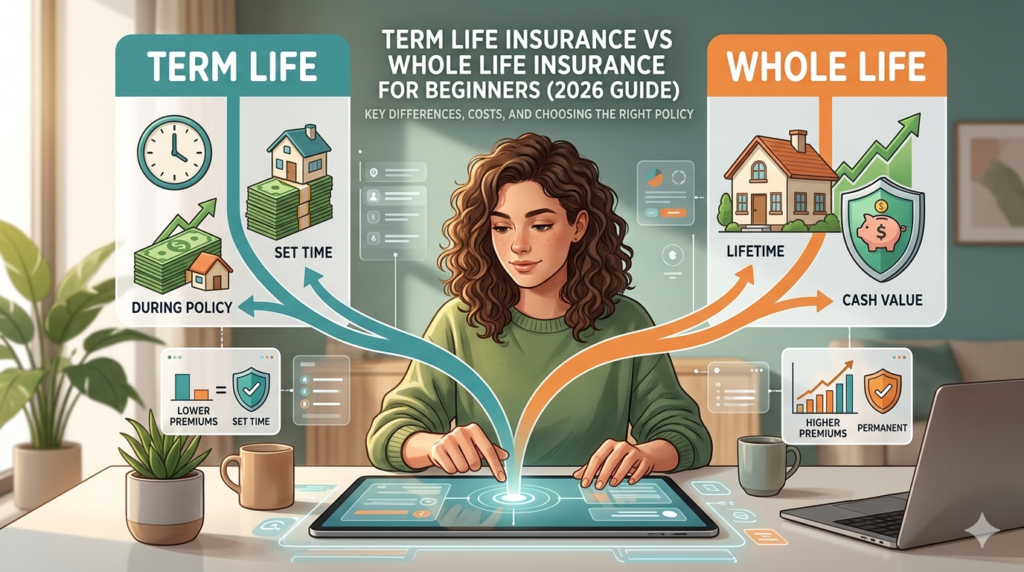
Most people put off buying life insurance for one reason: it’s confusing. You look it up, hit a wall of jargon, and quietly close the tab.
So let’s skip the jargon.
This is a plain-English guide to term life insurance vs whole life insurance for beginners, what each one does, what it costs, and how to figure out which one actually makes sense for your life. No fluff. No pressure.
First, Why Does Life Insurance Even Matter?
Here’s the simplest way to think about it.
If someone in your life depends on your income — a spouse, a kid, an aging parent — and you suddenly weren’t around anymore, what happens to them financially? Life insurance is the answer to that question.
It pays out a tax-free lump sum (called a death benefit) to whoever you name as your beneficiary. They can use that money to cover the mortgage, replace their income, pay off debts, or just keep the lights on while they figure things out.
That’s it. That’s the core of what life insurance does.
Now, the type you choose changes how it works, how long it lasts, and how much you pay.
What Is Term Life Insurance?
Term life is exactly what it sounds like. You’re covered for a set term — usually 10, 20, or 30 years. If you pass away during that window, your family gets the payout. If you outlive the policy, it just ends. No payout, no refund, no savings — it simply expires.
Think of it like renting an apartment. You’re not building equity. But you get solid protection for exactly as long as you need it, at a price that makes sense right now.
A quick example: Say you’re 32, just bought a home with a 30-year mortgage, and have two young kids. A 30-year term policy makes a lot of sense. It covers the years your family is most financially vulnerable. By the time it expires, your mortgage is paid off, and your kids are grown.
What makes term life worth considering:
- It’s affordable. A healthy 30-year-old can often get $500,000 of coverage for around $25–$30 per month. That’s less than most people spend on streaming subscriptions.
- It’s simple. There’s no investment component to track, no cash value to manage. It does one job.
- You can pick your timeline. Need coverage while your kids are at home? Go shorter. Have a 30-year mortgage? Match the term to that.
- Premiums don’t change. Whatever rate you lock in on day one, that’s what you pay every month for the life of the policy.
The one downside worth knowing:
If you outlive your term, you get nothing back. That bothers some people. It shouldn’t bother you too much. The point was never to get money back. The point was protection. And if you outlive it, that’s actually the best-case scenario.
What Is Whole Life Insurance?
Whole life insurance is permanent. It doesn’t expire after 20 years. As long as you keep paying, you’re covered — whether you die at 58 or 94.
But it’s more than just lifelong coverage. Whole life also builds cash value over time. Part of every premium you pay goes into a kind of savings account inside your policy. That cash value grows slowly at a guaranteed rate, and eventually you can borrow against it or withdraw from it.
A quick example: Someone buys a whole life policy at 35. By the time they’re 60, they’ve built up a meaningful chunk of cash value inside the policy. They borrow against it to help pay for a grandchild’s education — tax-free. When they pass away, their beneficiaries still receive the death benefit (minus any unpaid loans).
What makes whole life worth considering:
- It never expires. Your family will receive the death benefit no matter when you die. That’s a guarantee term can’t offer.
- It builds cash value. The savings component grows tax-deferred and can be accessed during your lifetime.
- Premiums stay level. You lock in your rate at purchase, and it never increases.
- Possible dividends. Many policies pay annual dividends if the insurer performs well financially. You can use those to grow your cash value faster or reduce your premium.
The honest downside:
Whole life costs significantly more. We’re talking five to ten times the monthly premium of a comparable term policy. That’s a real number that affects what coverage you can afford.
Term Life vs Whole Life Insurance: The Side-by-Side
Here’s the difference at a glance:
| Term Life | Whole Life | |
|---|---|---|
| How long does it last? | 10–30 years | Your entire life |
| Monthly cost | Low | Much higher |
| Death benefit | ✓ Yes | ✓ Yes |
| Cash value / savings | ✗ No | ✓ Yes |
| Premiums change over time? | No | No |
| What happens if you outlive it? | Coverage ends | N/A — it doesn’t expire |
| Best suited for | Income replacement, mortgages, young families | Estate planning, lifelong dependents, legacy goals |
Let’s Talk About the Real Cost Difference
This is where most beginners get a bit of a shock. Whole life insurance is not slightly more expensive than term. It’s a lot more expensive.
Here’s a rough picture for a healthy non-smoker buying a $500,000 policy in 2026:
| Age | 20-Year Term (per month) | Whole Life (per month) |
|---|---|---|
| 30, Male | ~$25–$30 | ~$300–$400 |
| 30, Female | ~$20–$25 | ~$260–$360 |
| 40, Male | ~$45–$55 | ~$500–$650 |
| 40, Female | ~$35–$45 | ~$420–$580 |
Approximate averages across major carriers, 2026. Your rate depends on your health, state, and the insurer.
The gap is hard to ignore. A 30-year-old woman could get $500,000 of term coverage for around $22/month. The same coverage in a whole life policy might cost her $300/month or more.
Now, whole life isn’t bad because it’s expensive. It’s just doing more things. The question is whether you actually need those things right now.
The “Buy Term, Invest the Rest” Idea
You’ll probably come across this argument at some point. It goes like this:
Instead of paying $350/month for whole life, buy a term policy for $28/month and put the other $322 into an index fund every month. Over 30 years, your investments will likely grow more than the cash value inside any whole life policy.
Mathematically? It often checks out if you’re actually disciplined about investing the difference every single month without fail.
Whole life, on the other hand, forces the savings for you. It’s built into the premium. Some people do better with that structure. There’s no shame in it.
Neither approach is objectively wrong. It really comes down to your personality, your discipline as a saver, and your broader financial goals.
Which One Should You Choose?
Here’s the honest answer: most beginners should start with term life insurance.
It’s affordable, it’s easy to understand, and it covers the years when your family is most financially exposed. For most people in their 20s, 30s, and 40s — especially those with kids, a mortgage, or debt- term life does the job extremely well.
Go with term life if:
- You want strong coverage at a price that fits your budget
- You have a mortgage, young kids, or income that others depend on
- Your goal is protection, not savings or investment
- You plan to build wealth through other means (401k, index funds, etc.)
Go with whole life if:
- You have a lifelong dependent, like a child with special needs, and need guaranteed lifetime coverage
- You’re in a high-income bracket and want an additional tax-advantaged savings vehicle
- Estate planning and leaving a legacy are a priority for you
- You’ve already maxed out your 401 (k) and IRA and want a conservative, permanent addition to your financial plan
Consider both if: You want a base of permanent whole life coverage for final expenses — say, $25,000–$50,000 — and a larger term policy to cover income replacement. This “layering” strategy is popular and often more cost-efficient than buying a single large whole life policy.
One More Thing Worth Knowing: Conversion Riders
Many term life policies come with something called a conversion rider. It lets you convert your term policy — or a portion of it — into a permanent whole life policy later on, without a new medical exam.
Why does that matter? Because if your health declines during your term and you later want permanent coverage, you’d normally face higher premiums or difficulty qualifying. A conversion rider protects you from that.
If you’re buying term life today, ask about this feature. It could be worth a lot down the road.
Don’t Wait on This One
Here’s the part people don’t love hearing: the longer you wait to buy life insurance, the more it costs. Premiums go up with age. And if your health changes in the meantime, you may pay significantly more — or have trouble qualifying at all.
The best time to buy was yesterday. The second-best time is now.
Start with a quote from two or three different insurers. Compare. And if you’re genuinely unsure which direction to go, talk to an independent insurance advisor — someone who isn’t tied to one company and can give you an honest recommendation based on your actual situation.
You don’t have to figure this out alone. You just have to start.
This article is for general informational purposes only and is not financial or insurance advice. Always consult a licensed insurance professional for guidance tailored to your personal situation.