
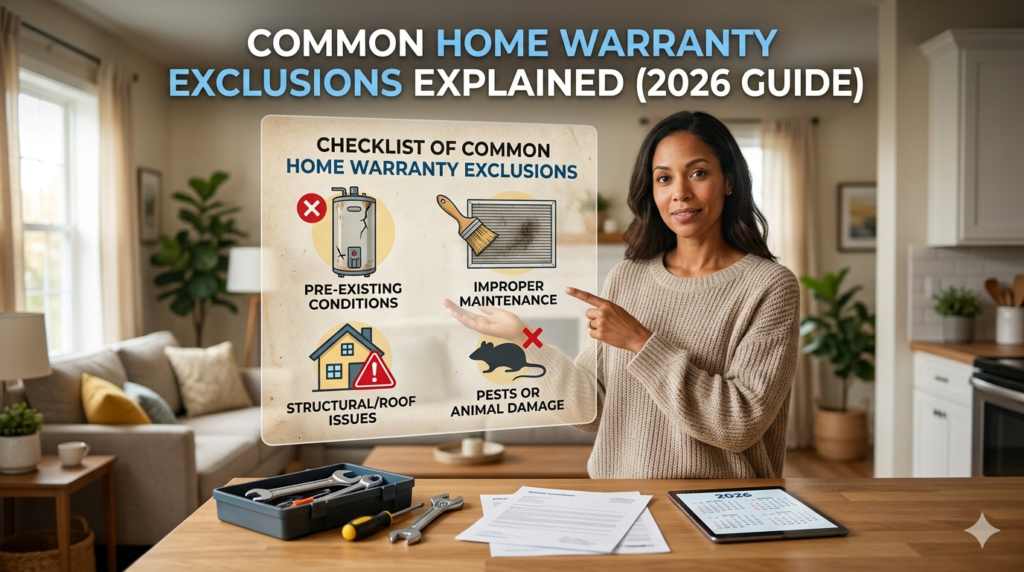
Picture this. Your furnace quits on the coldest night of the year. You grab your phone, file a claim, and wait. Then the inspector shows up, pokes around for 20 minutes, and tells you the breakdown was caused by a “pre-existing condition.” Claim denied.
Welcome to the part of the home warranty brochure nobody reads.
Home warranty companies are really good at telling you what they cover. Appliances, HVAC, plumbing, electrical sounds thorough, right? But buried in every contract is a list of home warranty exclusions that can flip a covered item into a denied claim faster than you’d expect.
This guide walks through every major exclusion in plain language. No jargon. No fluff. Just the stuff you actually need to know before you sign up or file a claim.
What’s a Home Warranty Exclusion, Really?
A home warranty exclusion is any situation, item, or condition that your provider won’t pay for — even if that system or appliance is listed as covered in your contract.
That part surprises people. You can have HVAC listed right there in black and white, and still get denied. The exclusion is what overrides the coverage.
Think of it this way: the coverage is the headline. The exclusions are the fine print that rewrites it.
Most standard plans share the same core exclusions. The details change by provider, but these categories show up almost everywhere:
| Exclusion Category | Why It’s Excluded |
|---|---|
| Pre-existing conditions | Problem existed before your coverage started |
| Poor maintenance | You didn’t keep up with routine upkeep |
| Bad installation | System wasn’t put in correctly from the start |
| Cosmetic damage | It looks bad but still works fine |
| Structural parts | That’s what homeowners insurance handles |
| Natural disasters | Also homeowners insurance territory |
| Secondary damage | Warranty covers the broken part, not the mess it made |
| Code upgrade costs | Bringing things up to code isn’t a “repair” |
| Pest damage | Mice, termites, ants — not covered |
| Outdoor items | Pools, sprinklers, outdoor kitchens don’t qualify |
| Coverage caps | Not an exclusion, but it acts like one |
Let’s break each one down.
Pre-Existing Conditions
This is the one that causes the most arguments. If a system had a problem before your plan started, the warranty company doesn’t have to pay for it.
Makes sense on the surface. But here’s where it gets frustrating: some providers will deny a claim even if you had no idea there was a problem. If their technician decides the damage “looks old,” that can be enough.
Real-world example: Say you buy a house in March and get a home warranty at closing. In October, your AC compressor dies. The tech says the compressor has been failing slowly for over a year, before your policy started. Claim denied, even though you bought the warranty in good faith.
How pre-existing conditions show up by system:
| System | What Gets Flagged as Pre-Existing |
|---|---|
| HVAC | Old refrigerant leaks, failing compressors, bad installation |
| Plumbing | Corroded pipes, slow leaks that got worse over time |
| Electrical | Burnt wiring, panel problems caught in a home inspection |
| Appliances | Units with error codes or missing parts before coverage began |
The exception worth knowing: Some providers — mostly those attached to home sales — offer limited coverage for unknown pre-existing conditions. That means problems that weren’t visible and couldn’t have been spotted during a normal walkthrough. If you’re buying a home, ask specifically about this before you pick a plan.
Lack of Maintenance (a.k.a. Neglect)
Home warranties cover things that wear out over time with normal use. They don’t cover things that broke down because nobody took care of them.
If your HVAC hasn’t been serviced in four years and finally gives out, the provider can say you didn’t maintain it properly and deny the claim. They can — and sometimes do — ask for service records to back up your side.
What this looks like in practice:
- HVAC that never got its annual tune-up
- The water heater was full of sediment buildup that had never been flushed
- Plumbing issues that got worse while being ignored
- A dishwasher that broke down from hard water buildup and no cleaning routine
Quick tip: Start a maintenance folder. It doesn’t have to be fancy — a Google Drive folder with photos of receipts works fine. Showing that you got the HVAC serviced last spring can be the difference between a paid claim and a denied one.
Bad Installation or Unauthorized Repairs
If a system was installed incorrectly originally, the warranty company won’t cover the fallout when it eventually fails because of that.
This one stings because it’s often not your fault. You move into a house where the previous owner had their brother-in-law wire the electrical panel on a Saturday. Everything has worked fine for two years. Then something gives out. The tech spots the bad installation, and suddenly you’re responsible for someone else’s corner-cutting.
The same goes for repairs. If you call an unlicensed handyman to fix a covered system — or you try to do it yourself — and it fails later, the provider can point to the unauthorized repair and walk away.
The rule: Always use licensed contractors for work on covered systems. Keep the invoices.
Cosmetic Damage
Your refrigerator has a dent in the door. The stove has a scuff on the side. The washing machine lid has a crack in the plastic. None of that is covered.
Home warranty exclusions for cosmetic damage are pretty simple: if it still works, it’s not a warranty issue. Warranties cover function, not looks.
Cosmetic things that don’t qualify:
- Dents, scratches, or chips on appliance surfaces
- Faded or discolored enamel
- Yellowed or cracked plastic trim
- Worn knobs or handles that don’t affect function
This is pretty reasonable, honestly. You wouldn’t expect your car insurance to cover a door ding. The same logic applies here.
Structural Parts of the House
Home warranties are not homeowners’ insurance. They cover systems and appliances. They don’t cover the physical structure of your house.
That means these are almost always excluded:
- Foundation cracks or shifts
- Load-bearing walls or framing
- Windows and exterior doors
- The roof itself (some plans offer limited roof leak add-ons, but the structure isn’t covered)
- Detached garages or sheds
If your foundation moves or a wall cracks, that’s a homeowner’s insurance claim. If your furnace breaks, that’s a home warranty claim. Two different products. Two different problems.
Natural Disasters and Acts of Nature
Flood, hurricane, tornado, earthquake, hail if nature breaks it, your home warranty won’t fix it.
This one matters because the damage can look ambiguous. A big storm rolls through. Your HVAC unit gets hit by a power surge. The unit was already covered under your plan, so you filed a claim. But the cause was a storm event, so the claim was denied.
Homeowners’ insurance is what handles storm and disaster damage. If you live somewhere that gets wild weather, make sure that policy is solid. A home warranty doesn’t fill that gap.
Secondary Damage (The Aftermath Problem)
This is one of the sneakier home warranty exclusions. Your warranty might cover the broken part. It won’t cover the damage the broken part caused.
Example: Your washing machine hose bursts while you’re at work. You come home to a flooded laundry room. The warranty might replace the washing machine. But the ruined flooring, the soaked drywall, the damaged subfloor? That’s on you — or your homeowners’ insurance.
Same story with:
- A refrigerator that leaks and warps the hardwood floor
- A water heater that floods the garage
- A dishwasher that causes ceiling damage in the room below
The warranty covers the appliance. It doesn’t cover the collateral damage.
Code Compliance Upgrades
This one doesn’t come up until it does, and then it’s expensive.
When a contractor replaces a covered system, they sometimes find that doing the job right means bringing things up to current building code. That extra work is not covered by most home warranty plans.
Real example: Your electrical panel needs a full replacement. That’s covered. But the job also requires running new wiring to meet 2026 code standards. That part? Not covered. You’re looking at potentially thousands of dollars in code upgrade costs on top of whatever the warranty pays.
Ask your provider directly how they handle code upgrades before you sign anything. Some plans will tell you upfront. Others won’t mention it until you’re mid-repair and staring at a surprise bill.
Pest Damage
Rodents chew through wiring. Termites hollow out walls. Ants get into appliance motors. If pests caused the damage, your home warranty doesn’t cover it.
This is a universal exclusion. Nearly every plan on the market draws a hard line at pest-related damage, regardless of how the claim is written up.
Pest damage falls under pest control service contracts or certain homeowners’ insurance riders — not home warranties. If you live somewhere with serious termite or rodent activity, that’s a separate coverage conversation to have.
Outdoor Systems and Items
Most home warranty plans are focused on the systems inside your house that keep it running — HVAC, plumbing, electrical, kitchen, and laundry appliances. Step outside, and coverage usually stops.
What’s typically excluded from base plans:
| Outdoor Item | Add-On Available? |
|---|---|
| In-ground sprinkler systems | Sometimes |
| Swimming pools and hot tubs | Sometimes |
| Septic systems | Sometimes |
| Well pumps | Sometimes |
| Outdoor kitchens / built-in grills | Rarely |
If you have a pool, a septic system, or a well, don’t assume they’re covered. Ask before you buy. Some providers offer add-on coverage for these items — but it’s never included in the standard plan.
Coverage Caps — Not an Exclusion, But Close Enough
Technically this isn’t one of the standard home warranty exclusions. But it acts like one, so it belongs on this list.
Most plans put a dollar limit on what they’ll pay per system, per claim, or per year. Once you hit that ceiling, you’re paying the rest out of pocket.
How this plays out:
| Repair Scenario | What It Costs | Warranty Pays | You Pay |
|---|---|---|---|
| HVAC replacement | $5,200 | $1,500 (plan cap) | $3,700 |
| New refrigerator | $1,400 | $500 (appliance cap) | $900 |
| Plumbing repair | $800 | $800 (within cap) | $0 |
The middle row is where people feel cheated. The warranty technically paid — it just didn’t pay enough to matter.
Always ask for specific per-system caps before you commit to a plan. A plan that costs $600/year sounds great until you find out its HVAC cap is $1,000.
Covered vs. Not Covered: A Quick Reference
| Situation | Covered? |
|---|---|
| AC stops working after normal use | ✅ Usually yes |
| AC fails due to a leak that existed before coverage | ❌ No — pre-existing |
| Refrigerator compressor dies | ✅ Usually yes |
| Refrigerator door has a dent | ❌ No — cosmetic |
| Pipes burst from a freeze | ❌ No — act of nature |
| Water heater leaks and floods the garage | ⚠️ Heater may be covered; flood damage is not |
| Pool pump breaks | ❌ Not in base plan |
| Furnace dies — code upgrade required to replace it | ⚠️ Furnace covered; code upgrade costs are not |
| Wiring chewed by rodents | ❌ No — pest damage |
5 Things to Do Before You Buy Any Home Warranty
1. Read the sample contract first. Any legitimate company will share it before purchase. If they won’t, move on. Find the “exclusions” section and read it slowly.
2. Ask how they handle pre-existing conditions. Specifically ask: What happens if a technician says the problem existed before my coverage started? What’s your appeals process?
3. Get your maintenance records together. Even basic documentation helps. A receipt from an HVAC tune-up, a water heater flush, a plumber visit — it all builds your case if a claim gets challenged.
4. Find out every coverage cap. Ask for a cap breakdown by system. Don’t guess. A plan with a $500 cap on appliances that cost $1,200 to replace is practically useless for that category.
5. Check what requires an add-on. Pools, septic systems, roof leaks, well pumps — if you have any of these, ask directly whether they’re in the base plan or whether you’d need to pay extra.
Pros and Cons of Home Warranties — The Honest Version
| Pros | Cons |
|---|---|
| Predictable service call costs | Long exclusion lists that surprise people |
| Covers wear-and-tear breakdowns | Claims can be denied based on technician opinions |
| One plan covers multiple systems | Coverage caps can leave you with a big out-of-pocket bill |
| Useful if multiple systems are aging | Maintenance requirements can void coverage |
| Transferable when selling a home | Customer service varies wildly by provider |
The Bottom Line
Home warranty exclusions aren’t some sneaky trick companies invented to avoid paying claims. They’re how the product is designed. A home warranty is a service contract for systems that wear out naturally over time, with proper maintenance, proper installation, and no outside damage factors.
Stay inside those lines, keep your maintenance records, and read the contract before you sign it. Do that, and a home warranty is a genuinely useful thing to have.
Skip that homework, and you might end up in a cold house in January, staring at a denial letter, wondering where it all went wrong.
Know what you’re buying. Then decide if it makes sense for your home.
Thinking about getting a home warranty? Check out our guide to the best home warranty companies — we break down coverage, caps, and real customer reviews so you can pick without the guesswork.