
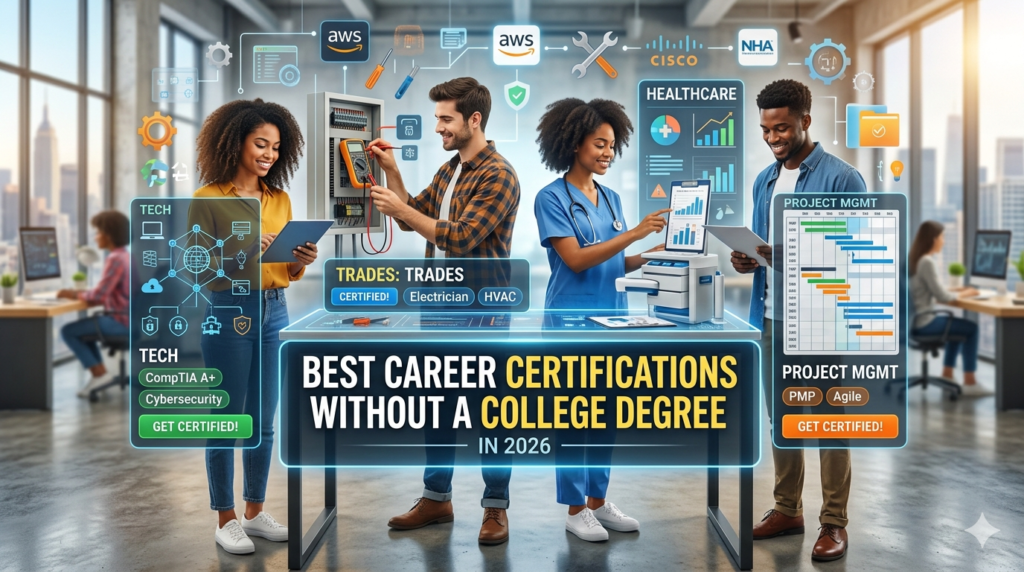
Hey, if you’re sitting there wondering whether you really need four years of college and a pile of debt to get ahead, you’re not alone. Plenty of folks are skipping the traditional route and doing just fine, sometimes even better—with the right certifications. In 2026, employers care more about what you can actually do than where you spent your late teens and early twenties.
I’ve seen friends and people online make real shifts this way. No magic formula, just smart choices and some hustle. Let’s talk through the best career certifications without a college degree that are actually worth your time right now. I’ll keep it real, no hype.
Why This Path Makes Sense These Days
College isn’t a bad choice for everyone, but it’s expensive and slow for a lot of us. Certifications let you learn specific skills fast, often while you’re still working or handling life stuff. Many cost a few hundred bucks and take just a few months.
And guess what? Big companies like Google, IBM, and others have loosened up on degree requirements. They want people who can solve problems, not just collect transcripts.
The payoff? You can get into fields paying decently from the start, with room to grow. Think $50k, $80k, even over $100k in some cases, depending on where you live and how far you take it. It’s not instant riches, but it’s a practical way forward.
Tech and Cybersecurity: Solid Options for Desk Folks
Tech keeps growing, and you don’t need to be a coding genius to start.
One of the easiest entry points is the Google IT Support Professional Certificate on Coursera. It covers basics like fixing computers, networks, and helping users. You can knock it out part-time in a few months for around $50 a month. Plenty of people land help desk jobs paying $50k to $70k to begin with.
From there, add something like CompTIA Security+. It’s respected, vendor-neutral, and opens doors to cybersecurity roles where salaries often hit $80k or more pretty quickly. I know a guy who went this route after retail work—he studied nights, passed the exam, and doubled his income within a year. Nothing flashy, just steady progress.
Other good ones: CompTIA A+ for hardware basics, Cisco CCNA if networking clicks with you, or cloud certs from AWS or Azure. These pair well if you like remote work or solving tech puzzles.
Project Management: Organize Chaos and Get Paid
If you’re the type who naturally keeps things on track, look at project management certs.
The Certified Associate in Project Management (CAPM) from PMI is a straightforward start. No crazy experience needed upfront. Or try the Google Project Management Certificate, practical and affordable. These can lead to coordinator or assistant roles pulling in $70k–$95k.
It’s not all spreadsheets and meetings. There’s a human side to it, like keeping teams motivated when deadlines loom. One buddy of mine used this to move from warehouse work into logistics coordination. He jokes that herding cats is easier with the right cert on your resume.
Trades: Hands-On Work That Pays the Bills
Don’t sleep on the trades. If you like working with your hands and seeing immediate results, these can be gold.
HVAC techs with EPA 608 certification often train in weeks or months. Demand stays high because of new buildings and climate stuff. Median pay hovers around $55k–$80k, with overtime bumping it up.
Electricians or plumbers go through apprenticeships where you earn while you learn—usually 4-5 years to full license, but the money gets good fast. Some top out well over $100k, especially if they start their own gig.
CDL-A for truck driving is another quick one. A few weeks of training and you’re on the road. Pay starts decent and climbs with experience or specialized skills. Owner-operators can really make it count.
These jobs aren’t for everyone—weather, physical demands, odd hours—but they offer stability and respect that office work sometimes lacks.
Healthcare Roles: Help People and Earn Steady
Healthcare always needs workers. Shorter programs get you in without massive schooling.
Certified Medical Assistant or phlebotomy tech training takes 3-12 months. Entry pay is around $35k–$55k, but it builds from there. Medical billing and coding is more behind-the-scenes and can even be remote.
These feel meaningful. You’re actually helping folks during tough times. And with an aging population, the work stays steady.
Other Strong Picks
Real estate license, state classes, and an exam, then commission-based earnings that reward hustle. Commercial pilots need more investment, but pay well if flying is your thing. Digital marketing or Salesforce certs suit sales-oriented types.
Quick Comparison Table
| Certification | Time to Finish | Rough Cost | Starting Pay Range | Good If You Like… |
|---|---|---|---|---|
| Google IT Support | 3-6 months | $300-500 | $50k–$75k | Computers & problem-solving |
| CompTIA Security+ | 3-6 months | $400+ | $80k+ | Tech security |
| CAPM / Google PM | 3-6 months | $200-500 | $70k–$95k | Organizing projects |
| EPA 608 (HVAC) | 1-3 months | $50-500 | $55k–$80k+ | Hands-on fixes |
| CDL-A | 4-8 weeks | $3k-7k | $50k–$80k+ | Driving & travel |
| Medical Assistant | 6-12 months | $1k-5k | $38k–$60k | Working with people |
Numbers vary by location and experience, of course. Check your area for the real picture.
Picking the Right One for You
Think about what fits your personality. Do you want to sit at a computer or be out moving around? Remote or on-site?
Look up local job listings on Indeed or LinkedIn. See what’s hiring near you and what they ask for. Factor in cost, time, and whether you need any basic experience.
Most of these just need a high school diploma or GED. Start small if you’re nervous—many have free intro materials.
Getting It Done: Practical Tips
Set aside consistent time, even if it’s just an hour a day. Use practice tests and labs. Build a simple portfolio or update your resume to highlight new skills right away.
Network a bit—Reddit groups, local meetups, or LinkedIn can connect you with people who’ve been there. One small win leads to another.
And remember, certs aren’t the end. Keep learning as you work. The folks who move up combine the paper with real-world grit.
One Real Talk Story
Take Maria—she was 29, stuck in customer service, and tired of dead-end shifts. She grabbed the Google IT cert while still working. Six months later, she switched to tech support. Two years on, she’s in cybersecurity, making twice what she did before. No degree, just steady steps and showing up. Stuff like that happens more than headlines suggest.
Challenges? Sure, But Manageable
No experience? Start entry-level and learn on the job. Money tight? Check for employer help, community colleges, or low-cost online options. Motivation dips? Find a study buddy or small rewards along the way.
Some fields have physical demands or shift work—be honest with yourself about that. And markets change, so stay flexible.
Wrapping It Up
The best career certifications without a college degree give you options without the heavy debt load. Whether it’s IT, trades, project work, or healthcare, pick something that matches your strengths and go after it.
You’ve got more paths open than ever. Start with one that feels doable, put in the work, and build from there. Who knows—you might look back a year from now and be glad you didn’t wait. What sounds interesting to you? Drop a comment if you want to chat about specifics.
FAQs
Can you actually get hired without a degree? Yeah, especially with the right certs and some proof you know your stuff.
What’s the fastest route to decent pay? CDL or basic HVAC stuff for quick starts.
Are online certs taken seriously? Absolutely, from places like Google, CompTIA, or AWS.
How much money are we talking? Varies, but many hit $50k–$100k+ with experience.
Best for total beginners? Google certificates are friendly starting points.