
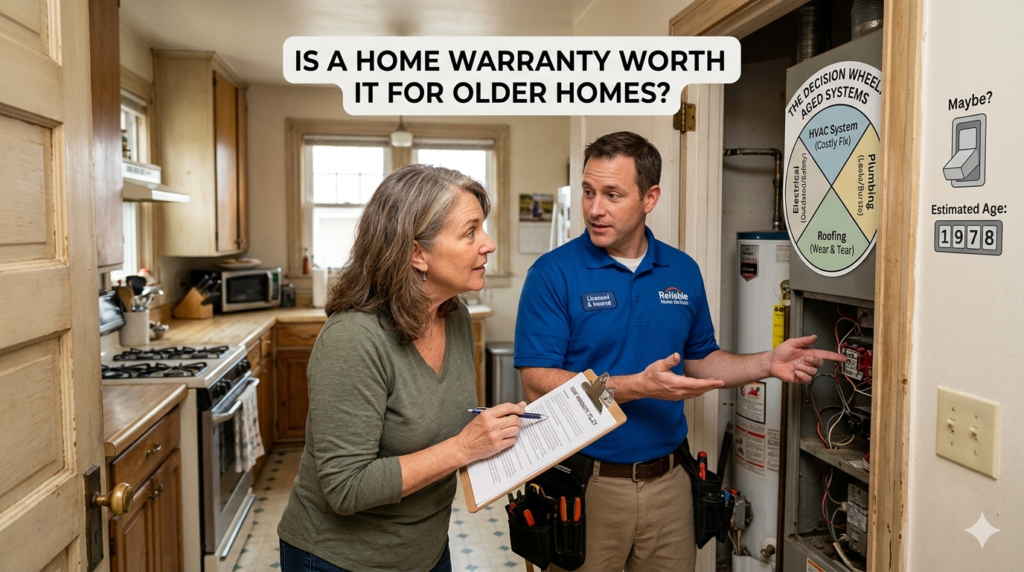
Picture this: it’s February. It’s cold. You wake up, and your house feels like a refrigerator because your actual furnace stopped working overnight. You call a technician. They show up, look serious, and say the words no homeowner wants to hear: “We’re going to have to replace the whole unit.”
You’re now staring at a bill anywhere from $5,000 to $12,000. And your savings account is not thrilled.
This is exactly the kind of situation a home warranty is supposed to help with. But here’s the real question: Is a home warranty actually worth it for older homes? Because buying a warranty for a brand-new house with factory-fresh appliances is one thing. Buying one for a 30- or 40-year-old house with aging systems is a whole different conversation.
Let’s get into it.
First, What Exactly Is a Home Warranty?
A home warranty is a service contract. You pay a monthly or yearly fee, and in return, the company agrees to help cover the cost of repairing or replacing certain home systems and appliances when they break down from normal use.
Think of it like a maintenance safety net. Not for accidents — that’s what homeowners insurance handles. This is for the slow, grinding wear and tear that happens when a water heater runs every single day for 15 years and eventually gives out.
Here’s a simple way to see the difference:
| Situation | Covered By |
|---|---|
| Furnace breaks down from age | Home warranty |
| Pipe bursts from a winter storm | Homeowners insurance |
| Dishwasher motor dies from normal use | Home warranty |
| Fire damages your kitchen | Homeowners insurance |
| Water heater stops heating after 12 years | Home warranty |
| Flood water ruins your floors | Homeowners insurance |
They’re two separate products. You need both. And for older homes, especially, a home warranty fills a real gap that insurance simply doesn’t touch.
Why Older Homes Face a Higher Risk (And Higher Bills)
Here’s the thing about older homes — they’re charming, they’re often built better than newer construction, and they have character. They also have systems that are quietly approaching the end of their useful life.
Most major home systems have a lifespan of 15 to 25 years. When you’re living in a home that’s 30, 40, or 50 years old, there’s a decent chance multiple things are overdue for replacement at roughly the same time. That’s not a small financial hit. That can be a devastating one.
2026 Replacement Cost Reality Check
| Home System / Appliance | Average Replacement Cost (2026) |
|---|---|
| Central HVAC system | $5,000 – $12,500 |
| Water heater (standard) | $1,000 – $3,500 |
| Electrical panel upgrade | $1,500 – $4,000 |
| Refrigerator | $800 – $3,000 |
| Washer / Dryer | $500 – $2,000 each |
| Plumbing repair (major) | $500 – $5,000+ |
| Oven / Range | $700 – $2,500 |
One bad year — HVAC and water heater both calling it quits — can cost you $8,000 to $15,000 out of pocket. That’s the kind of thing that wipes out an emergency fund in one swipe.
A comprehensive home warranty runs about $600 to $1,050 per year in 2026. When you stack that against what a single major repair costs, the math starts looking pretty interesting.
What Does a Home Warranty Actually Cover?
Most plans fall into three buckets. Here’s what each one typically includes:
Plan Types at a Glance
| Plan Type | What’s Covered | Typical Annual Cost |
|---|---|---|
| Appliance Only | Refrigerator, oven, dishwasher, washer, dryer | $300 – $600 |
| Systems Only | HVAC, plumbing, electrical, water heater | $300 – $600 |
| Comprehensive (Combo) | Both systems AND appliances | $600 – $1,050 |
For most people with older homes, the comprehensive plan makes the most sense. You’ve got aging appliances and aging systems. Why pick one category of risk to protect?
On top of the annual premium, you’ll pay a service fee (sometimes called a trade call fee) every time a technician visits. That typically runs $75 to $125 per visit, depending on the provider.
What Home Warranties Don’t Cover — And Why This Matters More for Older Homes
This is the section most companies don’t lead with. But if you’re buying a warranty for an older property, you need to know it cold.
Pre-Existing Conditions
If a system was already broken — or already breaking down — before your warranty started, most companies won’t cover it. Period.
Here’s the sneaky part: you don’t have to know it was broken. A technician can come out after a breakdown, determine that the issue was “already developing” before your start date, and deny the claim. In an older home with a 20-year-old HVAC unit, this is a real risk.
What to do about it: Get a professional home inspection before buying a warranty. Document the current condition of every major system. If something’s already struggling, fix it first, then get covered.
Some providers do cover unknown pre-existing conditions — things that couldn’t be spotted in a normal visual check. That’s a valuable feature for older homes. Ask specifically about it when comparing plans.
Poor Maintenance or DIY Work
If your HVAC failed because the filter hasn’t been changed in three years, the warranty company may deny the claim. The same goes for systems that were installed incorrectly by a previous owner or amateur repairperson.
Older homes have history. Sometimes that history includes a previous owner who “fixed” the plumbing themselves with questionable results. Companies can and do use maintenance and installation issues to reject claims.
Coverage Caps
Every plan has a ceiling on how much it’ll pay out. A plan might cap HVAC coverage at $1,500. That sounds helpful until the technician says the whole unit needs replacing and the job is $9,000.
For older homes, always check the caps. Look for plans with HVAC caps of $3,000 or higher. Some premium providers go up to $5,000 or more.
Other Common Exclusions
| What’s Not Covered | Why It Matters |
|---|---|
| Cosmetic damage (dents, scratches) | Appliances still function, no coverage |
| Structural elements (roof, walls, doors) | Insurance covers these |
| Items still under manufacturer’s warranty | They’re already protected |
| Damage from floods, storms, or fire | That’s homeowners insurance |
| Outdoor systems (unless added as extra) | Sprinklers, pools — usually not standard |
The Pre-Existing Condition Problem (A Real Example)
Let’s say Marcus buys a 1985 ranch house. The HVAC is original — pushing 20+ years. He signs up for a home warranty two weeks after closing, excited to have protection.
Six months later, the AC stops working. He files a claim. The technician comes out, inspects the unit, and reports back that the compressor showed signs of long-term deterioration that predated the warranty start date. Claim denied.
Marcus is out of the service fee and still has to pay for the repair himself.
This isn’t rare. It’s one of the most common complaints you’ll find in home warranty reviews. The lesson isn’t that warranties are a scam — it’s that going in blind without documenting your systems first is how you end up paying for nothing.
Is a Home Warranty Worth It for Older Homes? (Here’s the Honest Answer)
It depends on a few things. Here’s a clear breakdown:
It’s probably worth it if…
Your home systems are 15+ years old and haven’t been replaced. The older the system, the more likely it is to fail. A warranty spreads that risk into manageable monthly payments instead of one gut-punch repair bill.
You don’t have a large emergency fund. Not everyone has $10,000 sitting in savings earmarked for home repairs. If a major breakdown would genuinely strain your finances, a warranty gives you a floor.
Multiple systems are aging at the same time. It’s not just about one thing going wrong. When your HVAC, water heater, and dishwasher are all 18 years old, that’s a lot of risk sitting in one house.
You just bought the home and don’t know its full history. Older homes have stories. Sometimes those stories involve deferred maintenance or patchwork repairs. Coverage while you figure out what you’ve actually got can be smart.
It might not be worth it if…
Your systems have already been updated. A 1970s house with a new HVAC installed last year and a recently replaced water heater carries much less risk. The age of the house matters less than the age of its systems.
You have strong DIY skills and healthy savings. Some homeowners prefer to handle repairs themselves and skip the service fees. If you can manage a $10,000–$15,000 repair fund and aren’t afraid of maintenance work, self-insuring is a real option.
The exclusions would gut your protection. If your home has a boiler instead of standard forced-air, cast-iron plumbing, or a well pump — check whether those are actually covered before you sign. Some plans don’t touch non-standard systems.
Pros and Cons Summary
| Pros | Cons |
|---|---|
| Predictable monthly cost vs. surprise bills | Pre-existing conditions often excluded |
| Covers multiple systems and appliances | Coverage caps can leave you short |
| Good protection when systems are all aging | Service fees add up over time |
| Useful when home history is unknown | Claims can be denied on technicalities |
| Sellers can offer it to attract buyers | Requires reading the fine print carefully |
| Available for homes of any age | Not all systems/features are standard |
What to Look for in a Plan for an Older Home
Not every plan is built the same. Here’s what to specifically focus on when your home has some years on it:
HVAC coverage cap. Look for at least $3,000. Some premium plans go to $5,000. Budget plans that cap at $1,500 will leave you short on a full replacement.
Unknown pre-existing condition coverage. This one feature can make a major difference in an older home. Find out exactly how the company defines “unknown” before you assume you’re covered.
No age restrictions on systems. Some companies quietly exclude coverage for systems over 15 or 20 years old. If your furnace is 22 years old, confirm it’s actually eligible.
Service fee amount. Lower fees ($75 vs. $125) mean you’re more likely to call when something small goes wrong, instead of trying to ignore it and hoping it gets better. (It never gets better.)
Add-on coverage options. Older homes are more likely to have things like septic systems, well pumps, or older types of heating. Check if add-ons exist for your specific setup and what they cost.
Quick Numbers: What Does It Actually Cost in 2026?
| Coverage Level | Monthly Cost | Annual Cost | Service Fee Per Visit |
|---|---|---|---|
| Basic (appliances or systems only) | $25 – $50 | $300 – $600 | $75 – $125 |
| Mid-tier (combo plan) | $50 – $65 | $600 – $780 | $75 – $125 |
| Comprehensive (full coverage) | $65 – $90 | $780 – $1,050 | $75 – $125 |
If you file two claims in a year, say, a plumbing repair and a dishwasher replacement, you might spend $1,000 to $1,300 total (premium + service fees). A plumber alone for a serious leak can cost $500 to $2,000+. One covered appliance replacement can run $800 to $2,500. The numbers hold up when real breakdowns happen.
Selling an Older Home? A Warranty Is a Smart Move
If you’re on the selling side of this, offering a home warranty at closing is a low-cost way to make buyers feel a lot better about purchasing a property with some age on it.
Buyers walking through older homes are doing math in their heads: roof age, HVAC age, water heater age. Throwing in a one-year warranty (typically $400–$700 for the seller) says: “I know this house isn’t brand new, and I’ve got you covered for the first year.” It’s a confidence move.
If you’re the buyer, ask for it. Sellers will often say yes, and some warranty companies waive the normal 30-day waiting period for real estate transactions, so you’re covered from day one.
Before You Buy: A Simple Checklist
- Get a full home inspection and document every major system
- Repair any known issues before starting coverage
- Read the actual sample contract — not just the plan summary page
- Check for age restrictions on your specific systems
- Confirm HVAC coverage caps are high enough to matter
- Ask about unknown pre-existing condition coverage
- Check add-on options for non-standard systems
- Compare at least 3 providers side by side
- Read customer reviews specifically about the claims process
The Bottom Line
Is a home warranty worth it for older homes? For most people — yes. But only if you go in knowing what you’re getting.
An older home with aging systems is a genuine financial risk. A home warranty doesn’t eliminate that risk, but it takes the worst-case scenario, a $10,000 repair a year, and breaks it into something manageable. That’s a real benefit.
The homeowners who regret their warranty are usually the ones who didn’t read the fine print, skipped the home inspection, or bought a plan with caps too low to do any real work. The ones who love it are the ones who did their homework, picked the right coverage tier, and got a major repair paid for when they needed it most.
Do the homework. Pick the right plan. And stop lying awake listening to your 18-year-old furnace make that sound.
Thinking about comparing home warranty providers? Check our full guide to the best home warranty companies to find the right fit for your home and budget.