
Picture this. It’s a random Wednesday evening. You open the fridge to grab something for dinner, and it’s warm inside. Not a little warm. The room temperature is warm. Your fridge stopped working, and you have no idea when it happened.
You call a repair tech. They quote you $600 to fix the compressor. You didn’t budget for that. Nobody ever does.
That’s the exact moment most people wish they had a home warranty.
But here’s the thing — not everyone with a home warranty actually knows what’s covered. A lot of homeowners sign up, pay their monthly fee, and just assume everything in the house is protected. Then they file a claim and get denied. That stings.
So if you’ve been asking yourself what appliances are covered by a home warranty, you’re in the right place. This guide breaks it all down: what’s in, what’s out, what you can add on, and how to read the fine print without losing your mind.
First, What Even Is a Home Warranty?
A home warranty is a service contract. You pay a monthly or annual fee. In return, when a covered appliance or system breaks down from normal use, the warranty company sends a repair tech and pays for most or all of it. You usually only pay a small service fee when someone comes out, somewhere between $75 and $125.
It’s not the same as homeowners’ insurance. That’s a common mix-up.
Think of it this way:
- Homeowners insurance kicks in when something bad happens to your home — fire, storm, theft. It might cover your washing machine if a tree fell through the roof and crushed it.
- A home warranty kicks in when something just wears out. Your washing machine stops spinning because the motor gave out after eight years of laundry. That’s a home warranty situation.
One covers disasters. The other covers daily life.
So, What Appliances Are Covered by a Home Warranty?
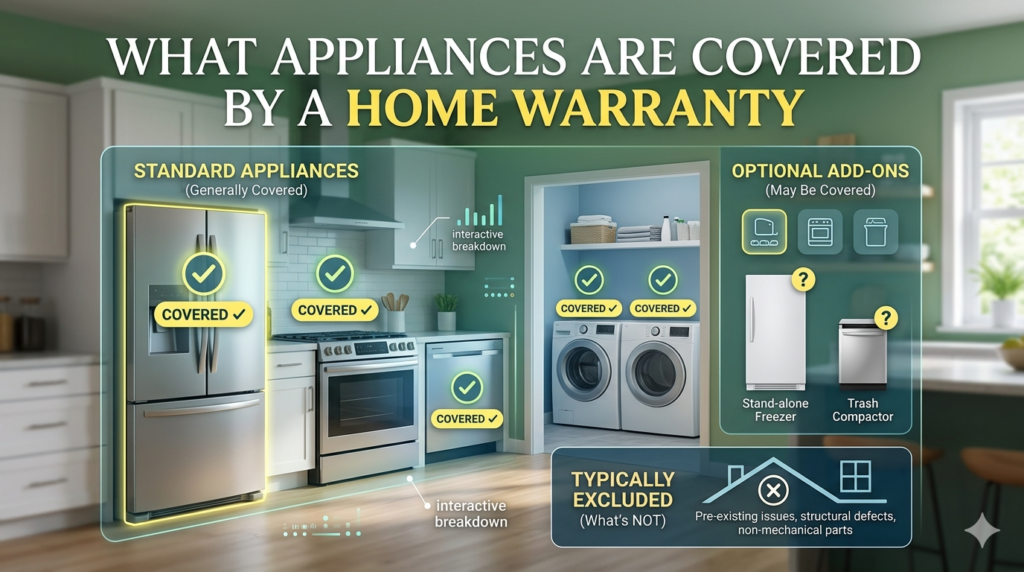
Most plans come in two versions: appliance-only plans and systems-only plans. A lot of homeowners pick a combination plan that covers both. Here’s a breakdown of what’s usually covered under the appliance side.
1. Refrigerator
Your fridge is almost always covered. That includes the compressor, thermostat, evaporator fan, ice maker, and water filter. Some plans even cover multiple fridges in the same house.
Why does this matter? A fridge compressor replacement alone can cost $400 to $700 in 2026. That’s more than most people pay for a full year of home warranty coverage.
Real example: Say your fridge is 9 years old and the ice maker stops working. Your home warranty sends a tech, you pay the $100 service fee, and the repair is handled. Without coverage, that same visit could easily run $250 to $400.
2. Oven, Range, and Cooktop
Gas or electric — it doesn’t matter. Ovens, ranges, and cooktops are standard on most appliance plans. Covered parts typically include heating elements, control boards, igniters, and burner components.
One small note: the oven door handle breaking or the glass getting scratched? That’s cosmetic. Not covered. But if the oven just stops heating? That’s what your warranty is for.
3. Dishwasher
Dishwashers are almost always on the standard list. The motor, pump, and control board are usually included. The tricky part is door seals and racks; some companies consider those cosmetic and leave them out. Worth checking your specific contract.
4. Built-In Microwave
Covered as long as it’s built in. Mounted over your range or installed in the wall? Yes, that’s covered. Sitting on your counter? Not a chance. No home warranty plan covers countertop microwaves.
5. Washer and Dryer
Here’s where it varies a bit. Some companies include the washer and dryer in their base appliance plan. Others put them in a higher-tier package. Either way, when they are covered, it usually includes motors, belts, drums, control boards, and timers.
These two appliances are worth confirming before you sign. Washer and dryer repairs are common and can easily cost $200 to $500 without coverage.
6. Garbage Disposal
Yes, this counts. Most standard plans include the garbage disposal. Motor failures and jammed blades from regular use are typically covered. Disposals aren’t that expensive to replace outright, but when it breaks at 10 pm, and you’ve got a sink full of dishes, you’ll be glad it’s covered.
7. Garage Door Opener
The opener mechanism, the motor, drive belt, and related parts are usually covered. The actual door itself, the springs, and the tracks? Those are often a different story and may not be included in your base plan.
8. What About Home Systems?
If you go with a combo plan, you’re also getting coverage for home systems, not just appliances. These are the big-ticket items that really hurt when they break.
| Home System | Typically Covered in Combo Plans? |
|---|---|
| HVAC (heating and cooling) | Yes |
| Water heater | Yes |
| Plumbing pipes and stoppages | Yes |
| Electrical system | Yes |
| Ductwork | Yes |
A furnace breakdown in January or a water heater that fails can cost $2,000 to $5,000 to fix or replace. That’s why combo plans exist.
The Full Appliance Coverage Cheat Sheet (2026)
Here’s a quick look at what’s typically covered, usually covered, add-on only, or never covered:
| Appliance | Coverage Status | Notes |
|---|---|---|
| Refrigerator | ✅ Standard | Ice maker, compressor, multiple units |
| Oven / Range | ✅ Standard | Gas and electric both included |
| Cooktop | ✅ Standard | Built-in only |
| Dishwasher | ✅ Standard | Door seals/racks may vary |
| Built-In Microwave | ✅ Standard | Must be installed, not countertop |
| Washer | ⚠️ Usually | Check if base or upgraded plan |
| Dryer | ⚠️ Usually | Same as washer |
| Garbage Disposal | ✅ Standard | Motor and blade failures |
| Garage Door Opener | ✅ Standard | Mechanism only |
| Pool / Spa Equipment | ➕ Add-on | Not in base plans |
| Well Pump | ➕ Add-on | Available with most providers |
| Septic System | ➕ Add-on | Not standard |
| Sump Pump | ➕ Add-on | Often excluded from base plan |
| Freestanding Freezer | ➕ Add-on | Separate from fridge coverage |
| Second Refrigerator | ➕ Add-on | Extra cost per plan |
| Countertop Appliances | ❌ Never | Toasters, blenders, coffee makers |
| Commercial Appliances | ❌ Never | Restaurant-grade not covered |
What Can You Add On?
Standard plans don’t cover everything. But most companies let you add on extra coverage for a fee. Here are the most common add-ons worth knowing about:
Pool and Spa Equipment — Covers pumps, heaters, and filters. If you have a pool, this one is important to add. Pool pump repairs can run $500 to $1,500.
Well Pump — If your home gets water from a private well, add this. Well pump replacements aren’t cheap.
Septic System — Not in standard plans but available as an add-on. Useful for rural homes.
Second Fridge or Freestanding Freezer — Got a spare fridge in the garage? Most base plans only cover one. This add-on protects the extra one.
Sump Pump — If you live somewhere that gets heavy rain or has a high water table, this is worth adding. A failed sump pump can mean a flooded basement.
What’s NOT Covered — Know This Before You File a Claim
This section could save you from a very frustrating phone call with your warranty company.
Countertop appliances — Coffee makers, blenders, toasters, air fryers, countertop microwaves. None of them is covered. Home warranties only cover permanently installed appliances.
Cosmetic damage — A dent in your fridge door, a cracked knob on your stove, rust on your dishwasher. If it looks bad but still works fine, the warranty won’t cover it.
Pre-existing problems — If your oven was already acting up before you started your policy, that claim will get denied. Coverage only applies to things that break after your plan starts.
Misuse and neglect — Stuffing non-food items into the garbage disposal. Overloading the washing machine until the drum cracks. Running appliances without proper maintenance. These aren’t wear and tear — they’re misuse. Not covered.
Still under the manufacturer’s warranty — If your brand-new dishwasher is still under its one-year factory warranty, your home warranty won’t step in. That’s the manufacturer’s job. Once that expires, the home warranty picks up.
Secondary damage — Your fridge leaks and warps your hardwood floor. The fridge repair might be covered. The floor? Probably not. Secondary damage from a covered appliance is usually excluded.
Structural changes needed for repair — If fixing your water heater means cutting into the drywall, the warranty covers the heater. The drywall work is on you.
Commercial-grade appliances in a home — Installed a restaurant-quality range in your kitchen? Most standard home warranty plans are built for residential appliances and won’t cover commercial-grade equipment.
Does Appliance Age Matter?
This is one of the most common questions people ask, and the answer is mostly no, but sort of yes.
Most home warranty companies don’t have a hard age cutoff. If your 12-year-old refrigerator was working fine when you signed up for coverage, it’s still covered when it breaks later.
The catch is this: older appliances are more likely to need expensive repairs. And some plans have per-item claim caps, say, $500 for a single repair. If your old compressor needs a $900 fix, you’re paying the $400 gap out of pocket.
The smart move: Before you sign, ask the company directly about coverage caps for older appliances. Most are willing to tell you. Some providers in 2026 have also started charging higher premiums for homes with appliances over 10 years old, so ask about that, too.
Pros and Cons of Home Warranty Appliance Coverage
Before you sign up, here’s an honest look at both sides:
Pros
- Predictable costs. You know your monthly fee. You know your service fee. No surprise $800 repair bills.
- One call handles it all. You don’t have to find a repair tech yourself. The warranty company sends someone.
- Covers multiple appliances. One plan can protect your fridge, oven, washer, dryer, and dishwasher at once.
- Great for older homes. If most of your appliances are 7 to 15 years old, the odds of something breaking are real. Coverage makes financial sense.
Cons
- Not everything is covered. Exclusions, cosmetic damage rules, and caps mean you might still owe money after a claim.
- You don’t pick the repair tech. The warranty company sends its contractor. You get who you get.
- Claims can be slow. Getting a tech scheduled and parts ordered can take days. That’s rough if it’s your only fridge.
- Monthly costs add up. If your appliances are new and under the manufacturer’s warranty, you might not need it yet.
5 Things to Check Before You Buy a Plan
Most people skip these steps. Don’t be like most people.
1. Look at the covered components list. Each appliance should have a list of what parts are included. “Refrigerator covered” is vague. What matters is whether the compressor is covered.
2. Find the claim cap amounts. Check what the max payout is per appliance per claim. If it’s $500 for an item that could cost $1,200 to fix, you’re still partly on the hook.
3. Read the exclusions. This is the part of the contract nobody reads. It’s also where the claim denials live. Spend five minutes on this section.
4. Know your service fee. Every time a tech comes out, you pay a service fee, usually $75 to $125. Some plans charge per visit; others per claim. Know the difference.
5. Check the service window. How quickly does the company dispatch a technician? In 2026, the best providers can get someone out in 24 to 48 hours. Others can take a week. For a broken fridge, that timeline matters.
Is It Worth It?
Here’s the honest answer: it depends on your situation.
If your appliances are brand new and still under the manufacturer’s warranty, you probably don’t need a home warranty yet. Wait until those warranties start expiring.
If your appliances are 7 to 15 years old, a home warranty starts making real sense. Appliances don’t last forever. The average refrigerator lasts about 12 to 15 years. Washers and dryers typically last 10 to 13 years. Once you’re in that range, breakdowns aren’t a matter of if, they’re a matter of when.
And when they do break, you’ll want a plan in place before it happens. You can’t buy a home warranty after the fridge stops working and expect the claim to go through. That’s like buying car insurance after you’ve already had the accident.
A home warranty won’t cover everything. But for the appliances it does cover, it can easily pay for itself in a single repair.
The Bottom Line
So, what appliances are covered by a home warranty? The short list includes your refrigerator, oven, dishwasher, built-in microwave, washer, dryer, garbage disposal, and garage door opener, depending on your plan. Combo plans add home systems like HVAC, plumbing, and electrical on top of that.
What’s not covered: countertop appliances, cosmetic damage, pre-existing issues, misuse, and commercial-grade equipment.
The key is reading the contract before you sign, not after you file your first claim. Check what parts are actually covered, know your service fee, and understand the claim caps. Do that, and a home warranty can be one of the smarter financial decisions you make as a homeowner.
Want to protect your home’s appliances without overpaying? Compare home warranty plans to find the right coverage for your specific setup.