
Nobody thinks they’ll fall for a loan scam. That’s kind of the problem.
People who get caught aren’t naive. They’re stressed. They need money, they found what looked like a real lender, and by the time something felt wrong, they’d already handed over their bank details or wired a “processing fee” to someone who never existed.
It’s happening constantly. The FTC reported that Americans lost over $12.5 billion to fraud in 2024, a new record. A significant slice of that came from fake loan offers and financial scams online. The FTC received nearly 19,000 complaints in the advance payment for credit services category alone. That’s not a fringe problem. That’s a very organized, very profitable industry built on targeting people who need financial help.
If you’re shopping for a loan right now — personal, business, or anything else, this is worth reading before you apply anywhere.
What Fake Loan Offers Actually Look Like
Here’s the frustrating part: they don’t usually look fake.
The most dangerous fake loan offers and financial scams online look clean, professional, and almost identical to real ones. Some scammers have put serious effort into their websites, email templates, and phone scripts. They’re not sending typo-ridden emails from a Gmail account anymore, well, some still do that. But the good ones? They’re convincing.
Here’s how fake loan offers tend to show up:
The advance-fee setup. You’re told you’ve been approved. There’s just one small fee you need to pay first for “processing,” “insurance,” or “loan verification.” You pay. The loan never arrives. The scammer is already gone. This method has been around for decades because it still works.
The copycat lender site. Some scammers build websites that look nearly identical to real banks or credit unions same color palette, a similar domain name, professional layout. You fill in your details thinking you’re applying legitimately. You’re not. You’re handing your information directly to the fraud.
The government impersonator. Someone contacts you claiming to be from the SBA or a federal relief program. They need your Social Security number to “process your eligibility.” There is no program. There’s just your SSN in someone else’s hands now.
The unsolicited text or DM. You searched for loan options last Tuesday. By Thursday, you’ve got a text from a company you’ve never heard of offering a pre-approved loan with a low rate and fast funding. They knew you were looking because your data was sold or harvested. And now they’re ready for you.
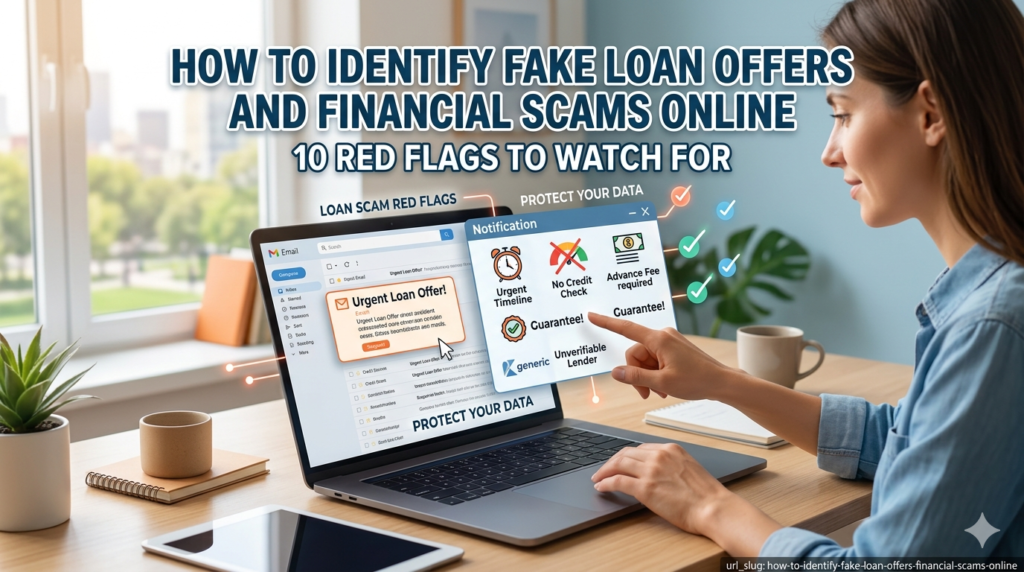
10 Warning Signs You’re Looking at a Fake Loan Offer
1. They’re Guaranteeing Approval Before Knowing Anything About You
No real lender does this. Not a bank. Not a credit union. Not even a lenient online lender. Lending is a risk calculation; they need to know you can pay them back. Credit score, income, existing debt, all of it. If a lender says “guaranteed approval regardless of credit history” or “no credit check required,” that’s a signal they’re not actually planning to lend you anything.
Those phrases aren’t generous. They’re bait. Real loan approval involves a review process because that’s how lending works.
2. They Want You to Pay Something Before They Pay You
This is the biggest, clearest warning sign of fake loan offers online, and it never changes, no matter how it’s dressed up.
Legitimate lenders don’t collect fees before releasing your loan. Any real fees, like an origination fee, come out of your loan amount after disbursement. You don’t wire $250 to “unlock” your funds. That’s not a thing.
Scammers rename this trick constantly: “loan security deposit,” “government tax,” “insurance premium,” “verification charge.” The label rotates; the scam doesn’t.
And if they ask you to pay using a prepaid debit card, gift card, or cryptocurrency? That’s your cue to leave the conversation entirely. Those payment methods are chosen because they’re nearly impossible to trace or get back.
Here’s how this plays out in real life: A man in his 50s needed $8,000 for a home repair. He found a lender online offering fast approval. They told him he’d been approved but needed to pay a $300 “insurance deposit” to release his funds. He paid. A week later, he paid another $150 “processing charge.” The loan never came. The company’s number was disconnected. He was out $450 and had nothing to show for it.
3. They Contacted You Out of Nowhere
You didn’t request this offer. You didn’t fill out an application with this company. But here they are in your inbox, in your texts, in your DMs with a personalized loan offer just for you.
Legitimate lenders advertise. But they don’t reach out to random individuals with tailored offers unless those people have an existing relationship with them or opted into something. Scammers buy stolen data, scrape lead lists, and specifically target people who’ve been searching for financial help recently.
If a lender found you, rather than the other way around, slow down before you respond.
4. The Terms Are Vague or Always “Coming Later.”
A real lender gives you the APR, the monthly payment, the total repayment amount, and any fees in writing before you sign anything. That’s not a bonus feature of legitimate lending; it’s a legal requirement.
When a lender keeps moving the goalposts on specifics, “we’ll confirm the rate once you’re approved,” “the exact terms depend on a few more steps,” “just sign here, and we’ll go over everything after,” that vagueness is deliberate. Putting real numbers in writing would either expose the scam or give you legal standing to push back.
5. They’re Creating a Fake Sense of Urgency
“This rate expires at midnight.” “We can only hold your approval for 24 hours.” “Act now or lose this offer.”
You’ve seen these lines in late-night TV commercials selling kitchen gadgets. They work the same way in financial scams online. The pressure is manufactured. It’s there to stop you from sleeping on it, Googling the company, or calling a trusted person first.
Any real lender will still exist tomorrow. If someone’s telling you the deal dies in two hours, they’re counting on you not looking too closely. Look anyway.
6. You Can’t Verify They’re a Real Business
Try this with any lender you’re not sure about: Google their name alongside the words “scam,” “complaint,” or “fraud.” Then look them up on the Better Business Bureau at bbb.org. Then check the NMLS Consumer Access database at nmlsconsumeraccess.org, that’s the official registry of licensed mortgage and lending companies in the US.
In most states, lenders must be licensed before they can legally offer loans to residents. If a company isn’t registered with your state’s financial regulatory agency, they’re operating outside the law. And if they’re outside the law, you have essentially no recourse if things go wrong.
A scam lender typically has a shiny website, no business registration, no physical address that checks out, and a contact page that goes nowhere. It looks real. But the paper trail simply isn’t there.
7. The Website Has Small Details That Don’t Add Up
Scam websites have gotten a lot better. Some look genuinely professional. But if you look carefully, the cracks are usually there.
Check the URL first. Scammers use domains like wellsfargo-quickloans.net or chaseapplication-center.com — close enough to a real brand to slip past a glance, but not the actual company. Look for the HTTPS padlock in your browser bar. Check when the domain was registered at whois.domaintools.com, a site created two weeks ago, which isn’t a real bank.
Also check for: no actual team page, generic stock photos everywhere, no physical address listed, minor typos in the copy, and a phone number that rings to nothing. Each one on its own might be explainable. Several together is a pattern.
8. They’re Asking for Sensitive Personal Information Way Too Fast
There’s a normal order to things when you apply for a real loan: you browse, you compare, you decide to apply, and then, through a secure application, you provide your details.
In a scam, the order is different. Someone contacts you with an exciting offer, gets you interested, and then immediately needs your Social Security number, your online banking credentials, or a photo of your ID before you’ve seen a single loan document or agreed to any terms.
That’s not how applications work. That’s identity theft in progress. Don’t hand over your SSN or banking login to any lender you haven’t independently checked out first.
9. Gift Cards or Prepaid Cards Come Up as a Payment Option
This one’s non-negotiable. If any person or company asks you to buy a prepaid debit card or a gift card of any kind and share the number with them as payment for loan fees, that is a scam. No exceptions.
No licensed financial institution accepts gift cards as payment. These cards show up in scammers’ scripts specifically because once you hand over the number, the money is gone and can’t be recovered. There’s no dispute process. There’s no chargeback. The money simply vanishes.
10. Something Sounds Real, But Your Gut Says Otherwise
This has gotten more complicated lately. AI tools are now letting scammers clone voices and generate emails that look and sound almost identical to correspondence from your real bank. You might get a phone call that sounds like a customer service rep you’ve actually spoken to. You might get an email formatted exactly like your lender’s real messages.
If the timing feels off, or the request seems unusual, or you just can’t shake the feeling that something’s not right, trust that. Don’t call the number they gave you. Hang up, go to your bank’s official website, find the real phone number there, and call that instead.
How to Vet Any Lender in About 5 Minutes
Before you share personal information with any lender online, run through this quick check:
BBB lookup. Go to bbb.org and search for the company name. Check ratings, how long they’ve been registered, and whether complaints exist.
NMLS Consumer Access. Visit nmlsconsumeraccess.org and verify they’re licensed in your state. This is a free public database.
State licensing check. Search “[your state] + lender license lookup” and confirm their name appears in the official registry.
Independent reviews. Check Google Reviews, Trustpilot, or ConsumerAffairs — not testimonials on their own site. Look for patterns in complaints, not just star averages.
Find their number yourself. Don’t call the number from any email or text they sent you. Look it up independently on their official site and call that.
This takes five minutes. It can save you a lot more than that.
What to Do If You Think You’ve Been Scammed
First — this happens to smart people. These operations are professional. Don’t let embarrassment stop you from acting fast, because fast action matters here.
Call your bank immediately. If money is left in your account, your bank may be able to freeze the transaction, reverse it, or, at a minimum, lock down the account from further access.
Report to the FTC at ReportFraud.ftc.gov. These reports feed into national fraud tracking and enforcement investigations.
File with the FBI’s IC3 at IC3.gov, especially if the scam involved wire transfers, email, or anything online.
Freeze your credit with all three bureaus: Equifax, Experian, and TransUnion. If you shared your SSN, a credit freeze stops anyone from opening new accounts in your name.
File a police report. Banks and identity recovery services often need one to start the resolution process.
Save everything. Screenshots, email threads, text messages, transaction records, all of it. Document before details get hazy.
The One Line You Need to Remember
If you take nothing else from this post, take this:
Real lenders never ask you to pay money before you receive money.
That single rule cuts through almost every fake loan offer and financial scam online. Whatever the fee is called, whatever story explains it, if a lender wants payment before they release your loan, it’s not a loan. It’s a scam.
Take your time when you’re shopping for financing. Run the five-minute check on any lender you haven’t heard of. And if anyone’s rushing you, let them rush. A real lender will still be there once you’ve had time to think it through.
The $12.5 billion Americans lost to fraud in 2024 didn’t disappear because people were reckless. It disappeared because scammers are patient, skilled, and constantly improving their pitch. Knowing what to look for is genuinely the best defense you have.
If this helped, pass it along to someone who’s currently shopping for a loan. The warning signs aren’t hard to spot once you know what they are — and that knowledge is worth sharing.