
Here’s a situation most people don’t see coming.
You’ve decided to take out a personal loan. You’ve compared a couple of lenders, you’ve got your numbers roughly in order, and then an application form asks whether you want a secured or unsecured loan.
And you think: wait, what?
It feels like a trick question. It’s not. But it is an important one. The type of loan you choose can affect how much you pay in interest, how easy it is to get approved, and here’s the part people tend to gloss over: what happens to your stuff if things go wrong.
So let’s talk through it properly.
Start Here: What These Two Terms Actually Mean
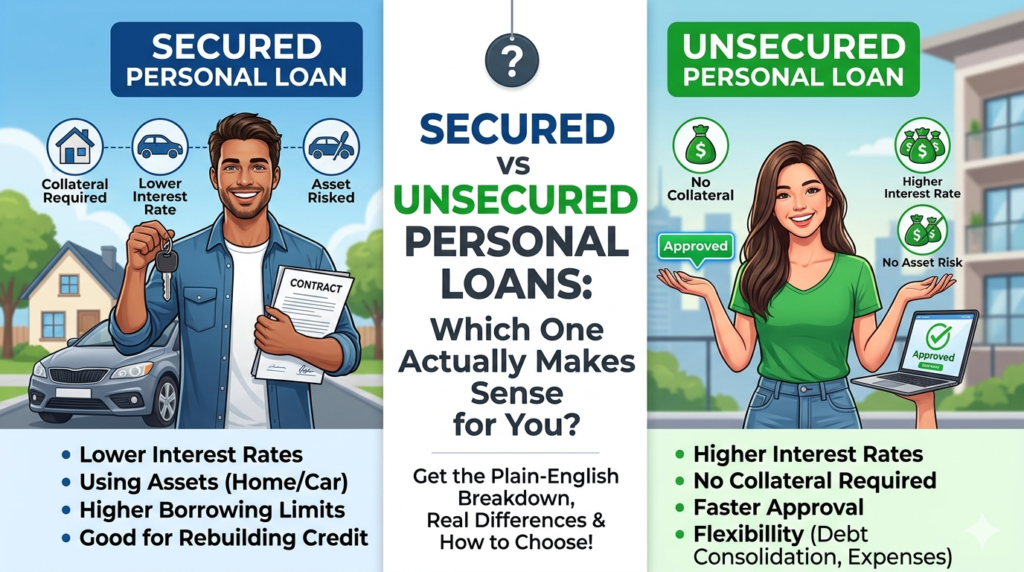
A secured personal loan means you’re backing the loan with something you own. An asset. Collateral. If you can’t repay, the lender can take that asset instead.
An unsecured personal loan means no collateral. You’re approved (or not) based on your credit history and income alone. Nothing physical is on the line — but your credit score very much is.
That’s it. That’s the whole distinction. Everything else, the interest rate differences, the approval requirements, the risk profile, all of it flows from that one fact.
Let’s Talk About Secured Loans First
Think of a secured loan like this: you’re giving the lender a reason to trust you beyond just your word.
You pledge an asset, your car, a savings account, maybe a certificate of deposit, and the lender holds the right to claim it if you stop making payments. You’re not handing it over. You keep using your car. Your savings account still earns interest. But that asset is now in play.
Assets lenders commonly accept as collateral:
- A paid-off car, truck, motorcycle, or RV
- A savings account or CD (certificate of deposit)
- Investment or brokerage accounts
- Jewelry, gold, or high-value collectibles
- A boat or other recreational vehicle
One option that doesn’t get enough attention: savings-secured loans. You borrow against money you’ve already got sitting in a bank account. The funds stay put and keep earning interest. The loan gets reported to credit bureaus. You pay it back, your score goes up. It’s actually a pretty smart way to build credit if that’s something you’re working on.
Because the lender has a fallback, they’re taking on less risk. Less risk for them almost always means a better deal for you, lower rates, more breathing room on your credit score, and sometimes a higher borrowing limit.
Now, Unsecured Loans
No collateral. No pledged assets. The lender looks at your credit score, your income, and your debt load, and decides whether to take a chance on you.
If your numbers are good, you get the money. Often fast. Some lenders fund the same day or the next business day. There’s no appraisal process, no asset paperwork, no waiting around.
The catch? Higher interest rates. Because the lender has no safety net, they price that extra risk into your APR. Sometimes noticeably so.
It’s worth knowing that unsecured personal loans are genuinely common. Americans are currently carrying more than $257 billion in unsecured personal loan balances, a record. This isn’t some obscure financial product. It’s something millions of people use for everything from consolidating credit card debt to covering a big home repair.
Secured vs Unsecured Personal Loans: The Key Differences
| Secured Loan | Unsecured Loan | |
|---|---|---|
| Collateral required | Yes | No |
| Typical APR | 6–15% | 10–36% |
| Credit score needed | Around 640+ | Usually 670+ |
| Loan limits | Higher | More limited (though up to $100K with some lenders) |
| Funding speed | Slower (asset review needed) | Faster |
| If you miss payments | Lender may seize collateral | Credit damage, possible collections |
The Interest Rate Gap Is Real — Here’s What It Looks Like in Practice
This is where the secured vs unsecured personal loan question starts mattering to your wallet.
Secured loans come with lower rates because the lender isn’t flying blind. One lender that offers both types reported that secured APRs run roughly 20% lower than their unsecured equivalents. That percentage might sound modest until you do the math.
Say you borrow $10,000 over four years. At 9% APR, a reasonable secured rate with decent credit, you’ll pay around $1,900 in interest. At 19% APR — a common unsecured rate for someone in the mid-credit range, you’re looking at closer to $4,200. Same loan. Same term. More than double the interest.
If your credit score is excellent, say 750 or above, unsecured lenders will offer you their best rates, and the gap shrinks considerably. But for anyone sitting in the middle of the credit spectrum? A secured loan can save a meaningful amount of money.
Credit Scores: How Much Do They Actually Matter?
They matter in both cases. Just differently.
With a secured loan, your credit score is still part of the picture, but the collateral cushions the lender’s concern. Someone with a 640 score and a paid-off car can still walk away with a reasonable rate. Better score, better rate, sure. But the door stays open for more people.
With an unsecured loan, your credit score does nearly all the work. Most lenders want to see at least 670. Below 640, many won’t approve you at all. And if they do, the rate may be high enough that you’d want to think twice before accepting.
Here’s a quick example that makes this real:
Two coworkers — call them Priya and Dan- both have a 635 credit score, and both need $7,000. Priya owns her car outright and uses it as collateral for a secured loan. She’s approved at 10% APR. Dan applies for an unsecured loan. He’s either turned down or offered 28% APR. Same credit profile, completely different outcomes, all because of that one structural difference.
Secured Personal Loans: The Good and the Not-So-Good
What works in your favor:
- Lower interest rates mean you pay back less overall
- Easier to qualify when your credit history isn’t spotless
- Access to larger loan amounts than many unsecured lenders offer
- A real option when unsecured lenders have said no
What to go in with eyes open about:
- If you stop paying, the lender can legally take your collateral, and that’s your car, your savings, your assets
- The application takes longer because the lender needs to verify what you’re pledging
- You need to actually own something worth pledging, not everyone does
Unsecured Personal Loans: The Good and the Not-So-Good
What works in your favor:
- Nothing you own is at risk beyond your credit score
- Faster application, faster funding, sometimes same day
- Available through a huge range of lenders
- Ideal for debt consolidation when your credit is in solid shape
What to go in with eyes open about:
- Higher rates, especially if you’re not in the top credit tier
- Stricter standards to get approved in the first place
- Defaulting still causes real damage, missed payments hit your credit, and can trigger collections or legal action
How to Actually Decide Between the Two
Skip the overthinking. It usually comes down to two questions:
Question 1: What’s your credit score? Below 640 look at secured loans. You’ll have better approval odds and more manageable rates. Between 640 and 700 — compare both and see what you’re offered. Above 700 unsecured loans are absolutely worth exploring, and you’ll likely get competitive rates.
Question 2: Are you comfortable putting an asset on the line? If the answer is no, and that’s a completely valid answer, then an unsecured loan is probably your lane regardless of your credit score. There’s no point getting a better rate if the risk of losing your car would keep you up at night.
Applying for a Personal Loan: What to Expect
Whether you go secured or unsecured, the process follows a similar path.
Check your credit score before anything else. Free access through your bank, Credit Karma, or annualcreditreport.com. Knowing your number tells you where to shop and what to expect.
Compare at least three lenders. Rates vary more than most people realize. A credit union might beat an online lender by several percentage points, or vice versa. Shop around.
Pre-qualify where you can. Most lenders offer a soft credit check that shows you estimated rates without affecting your score. Use this. An actual application triggers a hard inquiry, which does have a small impact.
Look at the APR, not just the interest rate. APR includes fees. It’s the number that tells you the true cost of borrowing. An origination fee of 3–5% can matter a lot on a large loan.
Borrow only what you need. Approval for more money than you asked for feels good. It’s not always your friend. Borrow the amount that solves the problem, not the maximum you can get.
Wrapping Up
Secured vs unsecured personal loans aren’t a good-or-bad situation. They’re just different tools built for different circumstances.
If your credit is strong and you want a clean, no-fuss borrowing experience, an unsecured loan is probably fine. If your credit needs work, you want a lower rate, or you need a larger amount, securing the loan with an asset can open doors that might otherwise be closed.
What matters most is that you understand what you’re agreeing to before you sign. Not just the monthly payment, but the full picture. What it’ll cost you in interest. What happens if something goes sideways? Whether the repayments are manageable on your real budget, not a best-case-scenario budget.
A loan that’s right for you shouldn’t feel like a risk. It should feel like a decision you made with your eyes open.
Disclaimer
This post is for informational purposes only and isn’t financial advice. Loan terms, rates, and eligibility vary by lender and individual credit profile. Talk to a qualified financial advisor before making any borrowing decisions.